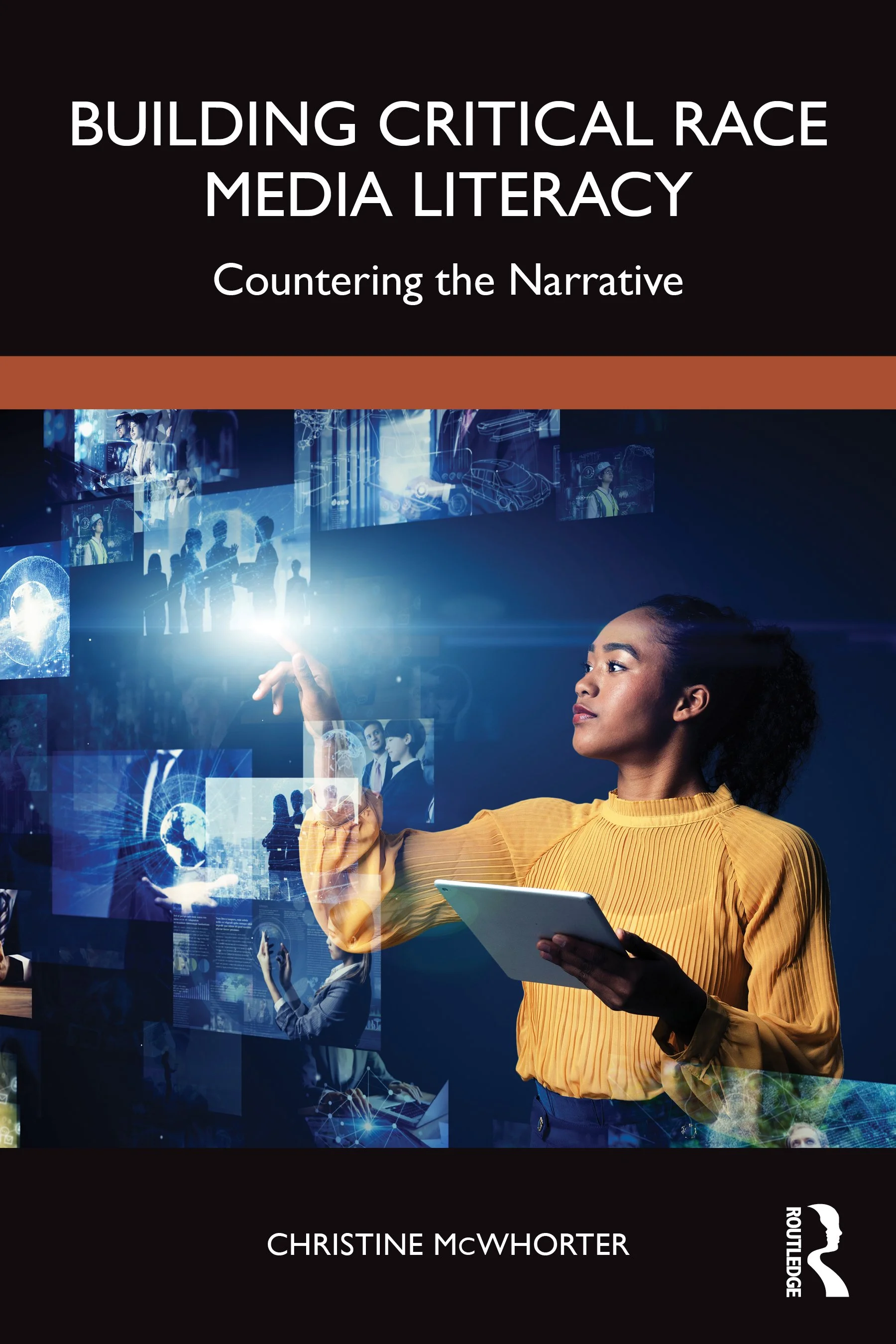
Building Critical Race Media Literacy: Countering the Narrative
This book examines how media has historically and systematically used race to justify inequality, distort truth, and normalize harm toward Black, Indigenous, and other racially marginalized communities. Across news, entertainment, education, and digital platforms, media does not simply reflect reality. It helps determine whose lives are protected, whose suffering is minimized, and whose experiences are treated as disposable.
Rather than teaching readers to look only for accuracy, the book offers a framework for reading media for design. Who benefits from the story being told? Who pays the cost when that story is repeated? And what happens when those narratives go unchallenged over time?
What This Book Argues
Media literacy is often taught as fact checking. This book argues that fact checking alone cannot protect communities from harm when the harm is built into media systems themselves.
Building Critical Race Media Literacy Through Storytelling introduces Critical Race Media Literacy as a framework for understanding how media has long maligned racially marginalized groups across platforms and over decades. It shows how racial narratives are produced, reinforced, and protected through ownership, representation, historical framing, algorithms, and policy.
Race is not an incidental factor in media. It is a central organizing logic. From textbooks to headlines, from film to digital feeds, racial meaning is constructed in ways that privilege dominant groups while criminalizing, erasing, or disciplining others. These patterns persist not because of isolated mistakes, but because the structure rewards them.
This book maps that structure.
What Readers Walk Away With
- How to identify racial master narratives across news, entertainment, education, and digital media
- How to recognize when “neutral” or “objective” framing is doing ideological work
- How racialized mis, dis, and malinformation operates differently than simple error
- How history is shaped through media rather than simply recorded
- How counternarratives function as tools for interruption, clarity, and resistance
Who This Book Is For
- Educators expected to teach “objectively” while racial harm is treated as controversy
- Journalists and media workers operating inside institutions that claim neutrality while reproducing inequality
- Students of any age who want to understand how media shapes race, power, and public truth
- Community leaders and organizers confronting narrative harm in policy, funding, and public discourse
- Anyone trying to make sense of why racial injustice persists even when the facts seem clear
No prior background in media studies is required.
Get the book, then bring this work to your classroom or organization
Request a Conversation